From Molecular Vibrations to Live Gas Sensing: Our Group at the RPTU University Information Day
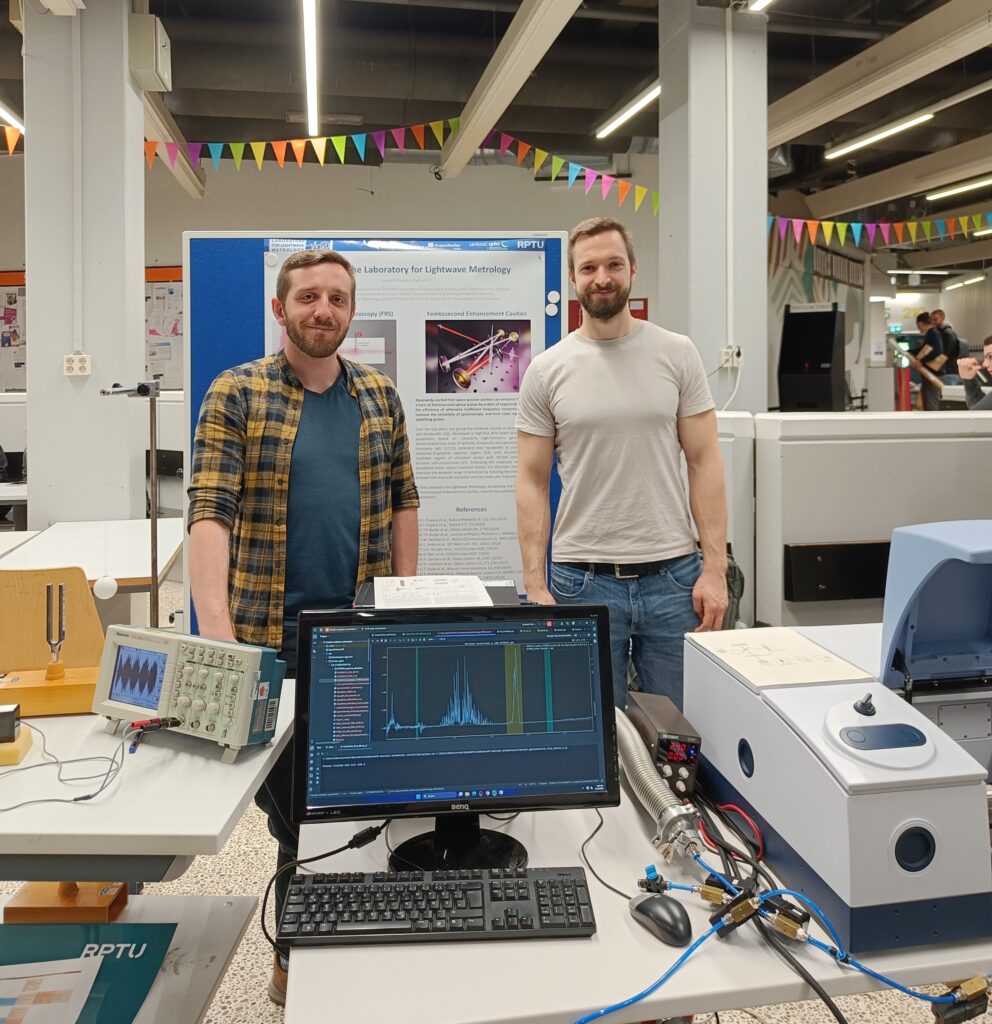
At this year’s University Information Day at RPTU, our group presented current research topics and hands-on experiments to interested high-school students and teachers. Our booth gave visitors insights into our work on modern laser-based spectroscopy, including a preview to our research topics of mid-infrared field-resolved spectroscopy, flow cytometry, and enhancement cavities.
A central goal of the booth was to make the basic principles of infrared spectroscopy tangible. For this purpose, we demonstrated a resonance experiment using two tuning forks, a tennis ball pendulum to make the vibrations directly visible, and a microphone to record the oscillations using an oscilloscope. The setup mainly showed that one vibrating tuning fork can excite another one only if both are resonant with each other. This seemingly simple experiment illustrates the same fundamental idea that underlies infrared spectroscopy: Molecules can be excited into vibrations when they interact with light of the right wavelength. In our research, we use these principles to investigate, for example, the constituents of breath gas and immune cells.
Building on this introduction, we also presented a live Fourier-transform infrared spectroscopy experiment measuring the CO₂ concentration in a gas cell flooded with ambient air. This experiment included every step from purging the measurement cell, to background measurements, sample measurements and real-time concentration retrieval. The retrieved concentration agreed very well with the expected value for the surrounding air and demonstrated how the basic concept of molecular vibrations can be translated into modern and meaningful measurement techniques.
We were happy to discuss these experiments with many curious students and teachers and to show how fundamental physics can lead to powerful tools for biomedical and chemical sensing. We hope that our demonstrations sparked the interest of many future scientists in physics, and especially in photonics and spectroscopy.